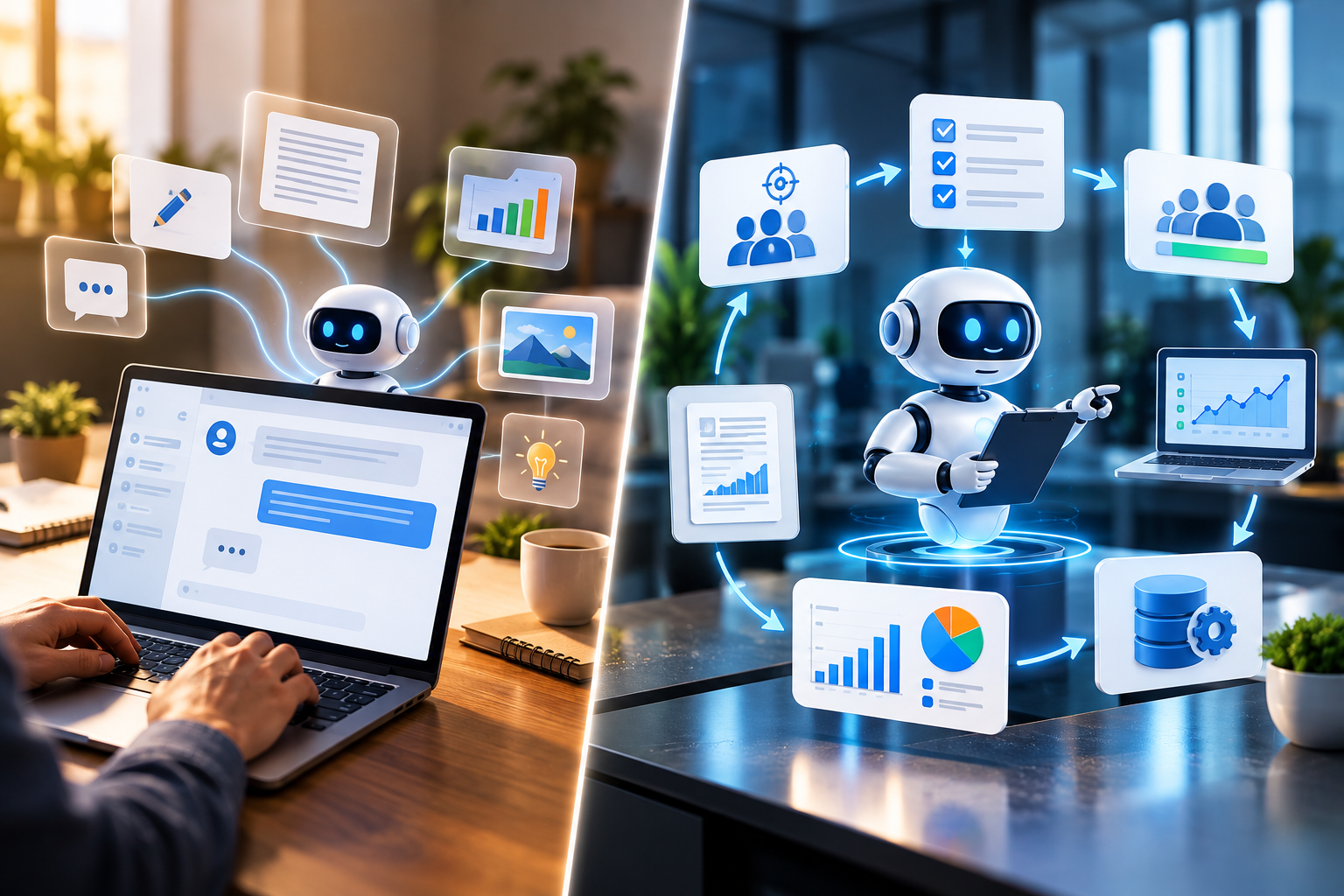
How agentic AI runs multi-step research workflows autonomously — the stack, seven live use cases, where it fails, and a 12-point checklist for evaluating platforms.
What is agentic AI?
Agentic AI describes systems that pursue a goal across multiple steps, deciding for themselves which actions to take and which tools to use, then checking their own work before continuing. The distinguishing feature is not intelligence. It is autonomy over the sequence.
A generative model answers the question you asked. An agentic system decides what questions need asking, asks them in order, gathers what it needs to answer each one, and stops when the original goal is met.
That difference sounds academic until you apply it to a research brief. "Find out whether our new subscription tier will sell in Germany" is not a question a model can answer. It is a project — market sizing, competitor pricing analysis, a survey with the right sample frame, price sensitivity modelling, and a synthesis. Generative AI helps with each piece if you hand it each piece. Agentic AI takes the brief.
Agentic AI vs generative AI vs traditional automation
The three get conflated constantly, usually by vendors with something to sell. The practical differences:
| Traditional automation | Generative AI | Agentic AI | |
|---|---|---|---|
| Input | A trigger event | A prompt | A goal |
| Path | Fixed, pre-programmed | Single-shot | Determined at runtime |
| Handles novelty | No — breaks | Partially | Yes, within its tool set |
| Uses external tools | Only what it's wired to | No, unless given | Yes, chooses which |
| Knows when it's wrong | No | No | Sometimes — via reflection steps |
| Output | Deterministic | Probabilistic | Probabilistic, with verification |
| Fails by | Stopping | Confabulating | Pursuing the wrong sub-goal well |
That last row matters more than the rest. When a rules engine breaks, you notice immediately. When an agent misunderstands the goal, it produces a complete, confident, well-formatted deliverable answering the wrong question. Detection is harder, which is why the governance section below is not optional reading.
The core loop: perceive, plan, act, reflect
Nearly every agentic system runs some version of a four-stage loop:
- Perceive — read the goal and the current state. What has been done? What is still missing?
- Plan — decompose the goal into the next concrete action. Not the whole plan, usually just the next step.
- Act — call a tool. Query a database, run a statistical test, fetch a competitor's pricing page, launch a survey to a panel segment.
- Reflect — evaluate the result. Did it work? Is the output plausible? Does the plan need revising?
Then it loops. The loop repeats until the goal is satisfied or a stopping condition triggers.
The reflect stage is what separates an agent from a script with a language model bolted on. An agent that cannot evaluate its own output is a very expensive chatbot.
Levels of autonomy
Autonomy is a spectrum, not a switch. Insights teams evaluating platforms should know which level they are actually buying, because vendors describe Level 1 products with Level 4 language.
| Level | Name | What the human does | Example in research |
|---|---|---|---|
| 0 | Manual | Everything | Analyst writes the survey, fields it, codes verbatims, builds the deck |
| 1 | Assisted | Everything, faster | AI suggests question wording; analyst accepts or rejects each one |
| 2 | Delegated | Defines the task, reviews output | AI codes 8,000 open-ends into a themed framework; analyst audits a sample |
| 3 | Supervised autonomous | Sets the goal, approves at checkpoints | AI designs, fields and analyses a concept test; analyst approves the questionnaire and signs off the findings |
| 4 | Fully autonomous | Sets the goal only | AI monitors brand health continuously and escalates only when something anomalous appears |
Level 3 is where most serious research value sits today, and where it should sit. Level 4 is appropriate for monitoring and alerting, where the cost of a false positive is a wasted hour. It is not appropriate for anything that ends in a capital allocation decision.
Why market research is a natural fit for agentic AI
Some domains take badly to agents. Research takes to them unusually well, for two structural reasons.
Research was always a multi-step workflow
Market research has never been a single task. It is a chain: define the question, design the instrument, identify and reach the right sample, collect responses, clean the data, analyse it, interpret it, and communicate the result to someone who will act on it.
Every link in that chain has a clear input, a clear output and a quality standard. That is precisely the shape of problem agentic systems handle well — decomposable, verifiable at each stage, with tools available for each step.
Compare that to a domain like brand strategy, where the steps are not separable and the quality standard is contested. Agents struggle there. In research, the chain is the workflow, and the workflow is the product.
Where the turnaround compression actually comes from
Research timelines are not dominated by thinking time. They are dominated by waiting and handoffs — waiting for a panel to fill, waiting for a data team to run a crosstab, waiting for a coder to work through verbatims, waiting for someone to build a deck.
An agentic pipeline compresses the timeline by removing the handoffs, not by thinking faster. When collection, cleaning, extraction and reporting run as one continuous process with no queue between stages, a study that took three months of elapsed calendar time can complete in under 48 hours of elapsed clock time. The analytical work was never the bottleneck.
This is worth being precise about, because it sets the right expectation. Agentic AI does not make analysis better by default. It makes the pipeline faster, which frees analyst attention for the interpretation work that actually requires judgement.
What an agentic research stack looks like
Four components, each of which you should be able to ask a vendor about directly.
Orchestration and task decomposition
The orchestration layer receives the goal and breaks it into an executable sequence. In a research context, it converts "validate demand for this product in three markets" into: define target segments, size each market, design the concept test, allocate sample across markets, field, monitor quality, analyse by segment, synthesise.
Good orchestration is adaptive. If the German sample comes back with insufficient responses in the 25-34 bracket, a well-built system re-fields that cell rather than reporting a finding with a hole in it. A poorly built one reports the finding.
Question to ask a vendor: what happens when a sub-task fails? Retry, escalate, or silently proceed?
Tool use
An agent is only as capable as the tools it can reach. In research those tools typically include panel APIs, survey platforms, web scrapers for competitor and pricing data, statistical engines for significance testing and conjoint analysis, NLP models for text, and visualisation layers for output.
The important architectural detail is that the agent selects the tool. It is not a fixed pipeline where step 4 always runs a chi-square test. It runs the test appropriate to the data it actually received.
Memory and context
This is the least-discussed and most consequential component. A stateless system treats every study as the first study. A system with memory knows what your brand tracked at last quarter, which segments have historically been volatile, and which competitor moves preceded the last share shift.
Limited memory AI — systems that retain and learn from recent observations without retaining everything indefinitely — is the practical middle ground. It gives you longitudinal continuity for brand tracking and trend detection without the governance nightmare of a model that has memorised every respondent it has ever seen.
Memory is what turns a series of disconnected studies into a continuously improving picture of a market. It is also where the meaningful privacy questions live, which is why it connects directly to the security and compliance discussion in a later pillar.
Retrieval over proprietary data
Retrieval-augmented generation lets an agent ground its output in your actual data rather than in the model's training corpus. When an agent reports that unaided brand awareness fell four points among 18-24s in Spain, retrieval is what makes that a statement about your dataset rather than a plausible-sounding sentence.
The test: ask the system for a finding and then ask it which specific responses support that finding. If it cannot produce them, it is generating, not retrieving.
Seven agentic workflows already running in market research
These are not projections. Each is in production somewhere today.
1. Autonomous survey and questionnaire design
An agent takes a research objective and produces a fielded-ready instrument: question wording, response scales, logic and branching, sample quotas, and a screening sequence. It checks for the standard design faults — double-barrelled questions, leading wording, unbalanced scales, missing "none of the above" options, ordering effects.
Where it beats humans: consistency and completeness. It does not get tired at question 40 and stop checking for bias.
Where it does not: instinct for the one strange question that unlocks the study. That remains human.
2. Continuous competitor monitoring
Rather than a quarterly competitive audit, an agent watches continuously — pricing pages, product launches, review sentiment, share of voice, hiring signals, ad creative — and reports when something changes materially.
The shift here is from periodic snapshot to continuous signal. Most competitive intelligence fails not because the analysis was wrong but because it arrived a quarter late.
3. Open-end coding and thematic analysis
Open-ended responses are where the actual reasons live, and they are the first thing cut when budgets tighten because coding them manually is slow and expensive.
NLP agents code thousands of verbatims into a themed framework, quantify theme prevalence, extract sentiment and intensity separately, and surface representative quotes. The analyst's job shifts from coding to auditing the codeframe — a far better use of expensive attention.
4. Anomaly detection and alerting
An agent monitoring metric streams flags statistically significant deviations as they occur: a sentiment drop in one market, a satisfaction score falling in one channel, a campaign underperforming in one segment.
This is the workflow best suited to Level 4 autonomy, because the output is an alert for a human to investigate, not a decision.
5. Automated segmentation and persona generation
Rather than segmenting on demographics because demographics are what you have, agents cluster on behaviour, stated values and purchase motivation, then generate segment profiles including size, distinguishing characteristics and likely messaging response.
The gain is iteration speed. Testing six segmentation schemes to find the one that actually predicts behaviour is a week of work manually and an afternoon with agents.
6. Report drafting and executive summarisation
Agents draft the findings document — structure, narrative, charts, and a recommendation section — from the analysed dataset. The draft is a starting point, not a deliverable. But starting from a complete draft rather than a blank page removes several days from most projects.
7. Natural language querying
A stakeholder asks "did the packaging change hurt us with older shoppers?" in plain language and gets an answer from the dataset in seconds, without filing a request with the insights team.
This is the workflow with the highest organisational impact and the highest governance risk, because it puts data interpretation in the hands of people who may not know what a confidence interval means. Guardrails matter: the system should refuse to answer questions the sample cannot support, and say so plainly.
Where agentic AI fails in research
Every one of these is real, and every one is manageable if you plan for it.
Hallucinated findings and fabricated support
The characteristic failure is not gibberish. It is a fluent, specific, plausible finding with no data behind it — a percentage that was never calculated, a quote that no respondent gave, a citation to a study that does not exist.
This is dangerous in research specifically because the output format looks identical whether the finding is real or invented. A fabricated statistic in a board deck is indistinguishable from a real one until someone checks.
Mitigation: every quantitative claim must trace to a query result. Every quote must trace to a response ID. Build traceability into the pipeline rather than spot-checking after the fact.
Sampling bias amplification
An agent that optimises for completion rate will, if unconstrained, gravitate toward the respondents easiest to reach. Those respondents are not representative. The agent will report a clean, statistically confident finding about a skewed sample.
This is worse than the equivalent human error because it happens faster and at scale, and because the output carries an unearned air of rigour.
Mitigation: quotas and representativeness checks must be constraints the agent cannot relax, not targets it tries to hit.
The synthetic respondent problem
Synthetic respondents — model-generated answers standing in for real people — are the most contested topic in the field right now, and the honest position is narrower than either camp claims.
They are defensible for pre-testing instruments, stress-testing a questionnaire for confusing wording, and estimating the range of plausible responses before committing budget to fielding.
They are not defensible as a substitute for real data in anything that informs a capital decision. A model trained on internet text reproduces the distribution of things people say publicly, which is not the distribution of what people do. The gap between the two is exactly the thing market research exists to measure.
Position to hold: synthetic respondents are a design tool, not a data source.
Why human-in-the-loop is not optional
The argument for keeping humans in the loop is not sentimental. It is that agents fail in a specific way — pursuing the wrong sub-goal competently — that only a human with context can catch.
The productive question is not whether to keep a human in the loop but where. Three checkpoints are sufficient for most studies:
- Before fielding — approve the instrument and the sample frame. Errors here contaminate everything downstream.
- After data collection, before analysis — review data quality flags and sample composition.
- Before delivery — verify that the top three findings trace to real data, and that the recommendation follows from the findings.
Everything between those checkpoints can run autonomously.
Governance: guardrails, evaluation and auditability
Three practices separate a research operation that can trust its agents from one that merely hopes.
Guardrails. Constraints the agent cannot override: minimum sample sizes per reported segment, quota enforcement, refusal to report findings below significance thresholds, prohibited data sources, and hard limits on what it can do without approval. Guardrails should be enforced in the orchestration layer, not requested in a prompt.
Evaluation. Agent performance needs measuring the way you would measure any researcher. Build a benchmark set — studies with known answers — and re-run it whenever the underlying model changes. Model providers update models continuously, and behaviour changes with them. An agent that coded verbatims accurately in March may not in September, and nothing will announce this.
Auditability. Every finding should be reconstructable: which data, which query, which model version, which prompt, which human approved what and when. This is a research-integrity requirement before it is a compliance one, though it is also a compliance one under GDPR's automated decision-making provisions and the EU AI Act's transparency obligations.
How to evaluate an agentic AI research platform
Twelve questions. Ask them in a demo and watch which ones produce a straight answer.
- What autonomy level is this actually? Map it to the 0-4 scale above. Ask them to place their product on it.
- Show me traceability. Pick a finding in the demo. Ask which specific responses produced it.
- What happens when a sub-task fails? Retry, escalate, or silently continue?
- Where are the human checkpoints, and can I configure them?
- What are the hard guardrails? Can the agent be instructed past them?
- How do you handle sample representativeness? Constraint or target?
- Do you use synthetic respondents, and where? Any answer other than a clear scope is a problem.
- How is the agent evaluated, and how often? Ask about model version changes.
- What is the data retention and residency posture? Where does data physically sit, and does it reach a third-party model provider?
- What certifications do you hold? SOC 2 Type II and its audit date, not "SOC 2 compliant."
- What is the panel quality control process? Bot detection, fraud screening, attention checks.
- What does the audit trail contain, and can I export it?
A vendor confident in their system will answer all twelve without deflecting. Deflection on questions 2, 5 or 9 is worth taking seriously.
Frequently asked questions
What is agentic AI in market research?
Agentic AI in market research refers to systems that take a research goal and execute the multi-step workflow needed to meet it — designing the instrument, collecting data, analysing it and reporting — deciding the sequence and tools autonomously rather than following a fixed script.
How is agentic AI different from generative AI?
Generative AI produces an output in response to a prompt. Agentic AI pursues a goal across multiple steps, selecting its own actions, calling external tools, and evaluating its own results before continuing. Generative AI answers; agentic AI executes.
Can AI agents replace market researchers?
No, and the framing misses what changes. Agents absorb the executional layer — fielding, coding, crosstabs, first-draft reporting. What remains human is deciding which question is worth asking, judging whether a finding is credible, and knowing what a business should do about it. The role shifts from producing research to directing and auditing it.
Are AI-generated market insights accurate?
Accuracy depends entirely on whether findings are grounded in real data and whether that data is representative. A system that retrieves from a verified panel with enforced quotas and full traceability can be highly accurate. A system generating plausible-sounding findings without retrieval is not accurate in any useful sense, regardless of how confident the output reads.
What are synthetic respondents and should I use them?
Synthetic respondents are model-generated answers that simulate survey responses. They are useful for pre-testing questionnaires and estimating response ranges before fielding. They should not substitute for real respondent data in any study informing a real decision.
How long does agentic AI research take compared to traditional research?
The compression comes from removing handoffs and queue time rather than from faster analysis. Studies that previously took weeks of elapsed calendar time can complete within days, because collection, cleaning, analysis and reporting run as one continuous process.
What is human-in-the-loop and where should the humans be?
Human-in-the-loop means humans review and approve at defined points rather than supervising every step. For most studies, three checkpoints suffice: approving the instrument before fielding, reviewing data quality before analysis, and verifying findings before delivery.
Is agentic AI safe to use with confidential product concepts?
It depends on the platform's controls, not on the AI. The relevant questions are whether data reaches third-party model providers, whether encryption is applied in transit and at rest, whether access is role-restricted, and whether confidential stimulus carries forensic watermarking. Ask for the answers in writing.