AI agents can draft questionnaires, flag leading questions, and catch double-barreled items. Learn what they do well, where they fail, and how to review them.
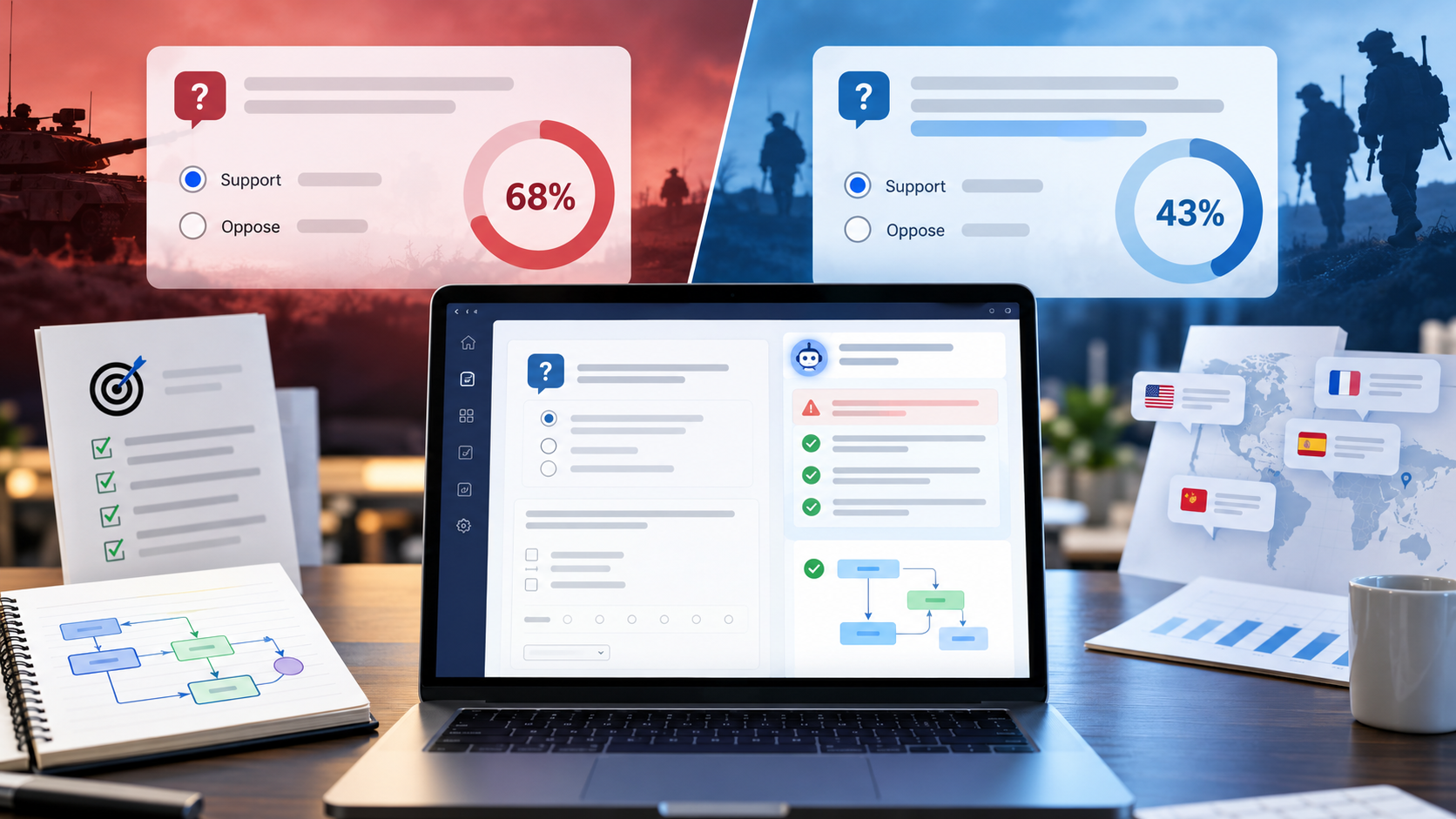
Small wording choices can move survey results a long way. In a 2003 Pew Research Center survey, 68 percent of respondents favored military action in Iraq when asked directly. When the question added "even if it meant that U.S. forces might suffer thousands of casualties," support fell to 43 percent. Same topic, one added clause, a 25-point gap.
That is why AI survey design deserves a careful look. AI agents can now draft questionnaires, check wording, and test logic in minutes. They are good at some of this work and poor at other parts of it. This article, part of our series on agentic AI in market research, explains where agents help, where they fail, and how to review what they produce.
What AI Survey Design Means
AI survey design is the use of AI, usually a language model working inside an agent, to turn a research brief into a questionnaire and then check it for common faults: leading wording, double-barreled items, unbalanced scales, broken routing, and order effects. The agent drafts and checks. A researcher decides.
If you are new to agents, our explainer on what an AI research agent is covers the basics.
Where AI Agents Help
Turning a Brief into a First Draft
An agent can read a brief, list the decisions the research must support, map each decision to the measures it needs, and draft questions for each. That map is useful on its own. It shows quickly when a question serves no objective, or when an objective has no question.
Catching Wording Problems
Many survey wording faults follow known patterns, which makes them a good fit for automated checks. Pew Research Center warns that questions asking respondents "to evaluate more than one concept (known as double-barreled questions)" are "difficult for respondents to answer and often lead to responses that are difficult to interpret." An agent can scan every item for two concepts joined by "and," for loaded adjectives, and for questions that assume facts the respondent may not share.
Some platforms build this check in. The Merkmetryx platform, for example, includes automatic bias and leading-question detection, which its product page describes as "flagging leading questions, detecting redundancy."
Checking Order and Flow
Earlier questions shape later answers. Pew reports that 88 percent of respondents said they were dissatisfied with the way things were going in the country when asked right after a question about presidential approval, compared with 78 percent without that context. An agent can flag sensitive questions that follow related ones, suggest where to place general questions before specific ones, and recommend rotation where order could bias results.
Balancing Scales and Answer Options
Scale design has well-documented traps. Pew notes that agree-disagree formats can produce "acquiescence bias," a tendency to agree with statements that is stronger among less educated and less informed respondents. It also notes that respondents in self-administered surveys tend to pick options near the top of a list (a primacy effect), while telephone respondents tend to pick options heard last (a recency effect). An agent can check that scales are balanced, suggest item-specific wording in place of agree-disagree statements, and recommend randomizing option order where it makes sense.
Testing Logic before Launch
Routing errors can be expensive, because they may surface only after fieldwork, when the missing data cannot be recovered. An agent can run thousands of simulated paths through a questionnaire to find dead ends, impossible skips, and quota cells that no path can reach. This is a technical check of the survey's logic, not a substitute for testing with real people.
Adapting Surveys across Markets
Multicountry studies need translations that keep meaning, not just words. Agents can produce first-draft translations, flag idioms that will not travel, and check that scale labels stay balanced in each language. Merkmetryx states that its platform supports more than 40 languages. A native-speaking researcher should still review every version.
Where AI Agents Still Fail
They Do Not Know the Decision behind the Survey
An agent can write a perfect question about the wrong thing. If the brief says "measure satisfaction" but the real decision is whether to cut a product line, the survey needs questions about substitution and switching, not satisfaction. Only someone who knows the business context will catch that.
They Write Fluent Questions People Cannot Answer
Language models write smoothly, which can hide a basic problem: the respondent may not know the answer. "How many times did you buy sparkling water in the past 12 months?" reads well but asks for recall few people have. A researcher would shorten the period or ask about the last purchase instead.
They Inherit Bias from the Brief
If the brief is written by a team that already believes in a product, its language can carry that belief. An agent drafting from that brief can turn "our innovative new formula" into question wording. The leading-question check helps, but the cleanest fix is a neutral brief.
They Cannot Replace Pretesting with Real People
Pew describes pretesting as "an essential step in the questionnaire design process." Simulated runs check logic. They do not show you how a real person interprets a question, where they hesitate, or which term means something different in their region. A handful of cognitive interviews or a soft launch with real respondents still matters.
They Cannot Choose the Format for You
Whether to ask an open or a closed question depends on what you need to learn. In a 2008 Pew post-election survey, 58 percent of respondents chose the economy when it was offered as an answer option, but only 35 percent named it in an open-ended version of the question. Neither number is wrong. They answer different questions, and choosing between them is a research decision.
A Review Checklist for AI-Drafted Questionnaires
Before any AI-drafted survey goes to the field, check that:
- Every question maps to an objective, and every objective has a question.
- No question asks about two things at once.
- No question assumes a fact or signals a preferred answer.
- Respondents can realistically know the answer.
- Scales are balanced, with clear and consistent labels.
- Option order is randomized where order could bias choices.
- Sensitive or specific questions do not sit right after related ones that could prime them.
- Routing has been tested, and every quota cell can be reached.
- Translations have been reviewed by a native speaker.
- A small group of real respondents has completed the survey before full launch.
Splitting the Work between Agent and Researcher
| Task | Agent | Researcher |
|---|---|---|
| Map objectives to measures | Drafts the map | Confirms it matches the decision |
| Draft questions | Writes the first version | Edits for context and feasibility |
| Wording checks | Flags leading, loaded, and double-barreled items | Decides which flags matter |
| Order and flow | Suggests placement and rotation | Approves the final order |
| Logic testing | Runs simulated paths | Reviews any failures |
| Pretesting | Prepares the soft launch | Interprets what real respondents did |
We covered other early-stage pitfalls in 10 Costly Market Research Mistakes.
Frequently Asked Questions
Can AI write a good survey?
AI can write a solid first draft and catch many common wording faults. It cannot judge whether the survey serves the business decision, and it cannot replace pretesting with real people. A researcher should review every AI-drafted questionnaire.
What is a double-barreled question?
It is a question that asks about two things at once, such as "How satisfied are you with the price and quality of this product?" Respondents who feel differently about price and quality cannot answer accurately. Split it into two questions.
How does AI detect leading questions?
AI checks wording against known patterns of bias, such as loaded adjectives, assumed facts, and phrasing that signals a preferred answer. It then flags those items for a researcher to rewrite.
Should I use synthetic respondents to test my survey?
Simulated runs are useful for checking routing and logic. They do not show how real people interpret questions, so follow them with a soft launch or cognitive interviews.
To see how automatic bias and leading-question detection fits into a full research workflow, explore Merkmetryx solutions.
Sources
- Pew Research Center. "Writing Survey Questions." Methods guide.
- MerkMetryx. "Product." Accessed October 5, 2026.