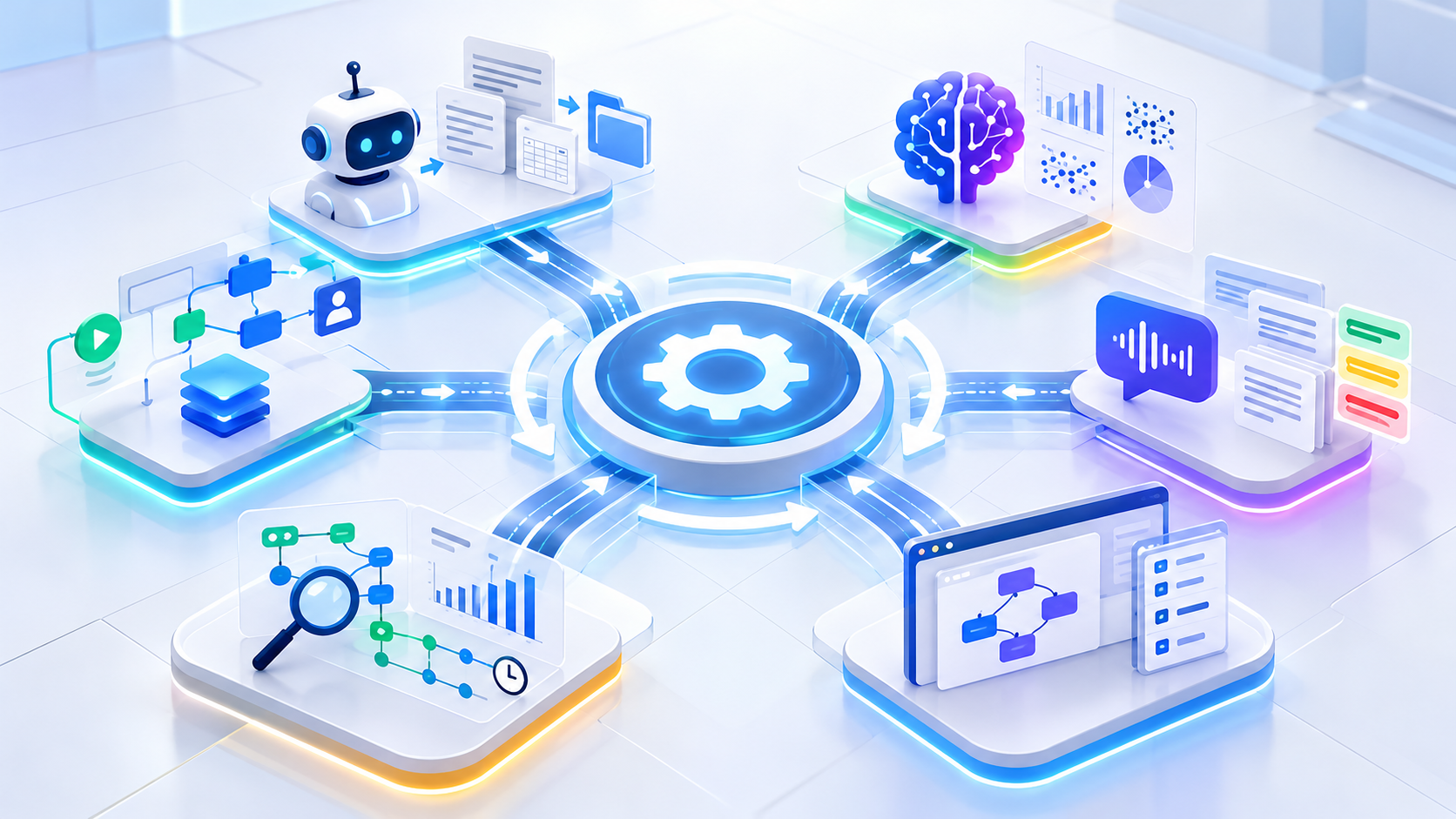
RPA, machine learning, NLP, process mining, orchestration, and low-code: the six building blocks of a hyperautomation stack and how each serves research teams.
Hyperautomation is not a product you buy. It is a stack of technologies that work together to automate a whole process. Knowing the hyperautomation components, and what each one is for, helps you see which parts you already have, which you are missing, and which a vendor is quietly leaving out.
This article breaks the stack into six building blocks and shows how each one applies to research operations. For the bigger picture, start with our guide to hyperautomation in market research. If you are still sorting out the terms, Hyperautomation vs. RPA vs. AI Automation covers the differences.
Where the Six Blocks Come From
Gartner, which placed hyperautomation first among its top strategic technology trends for 2020, described it as "the combination of multiple machine learning (ML), packaged software and automation tools to deliver work." Its 2021 definition named specific technologies: "robotic process automation (RPA), low-code application platforms (LCAP), artificial intelligence (AI) and virtual assistants."
We group those technologies into six blocks that map cleanly onto research work: RPA, machine learning, natural language processing, process mining, orchestration, and low-code tools.
1. Robotic Process Automation (RPA)
RPA is software that repeats rule-based steps a person would otherwise do on a screen. IBM describes it as performing "repetitive office tasks of human workers, such as extracting data, filling in forms, moving files and more."
In research: downloading fieldwork exports, uploading files to shared drives, copying respondent counts into status trackers, and sending scheduled reports.
What to check: what happens when a screen or file layout changes. A good setup alerts you when a bot fails rather than letting it run on bad inputs.
2. Machine Learning
Machine learning is the block that predicts and classifies. It learns patterns from past data and applies them to new data, which lets automation handle cases that no fixed rule covers.
In research: scoring respondents for fraud risk, building segments, forecasting demand, and flagging unusual movement in tracked metrics. MerkMetryx, for example, says its Limited Memory AI supports demand forecasting up to 90 days ahead and reports 94.2 percent forecast accuracy, which it states was validated against 12-month rolling actuals.
What to check: how accuracy was measured, on what data, and how often models are retrained. A model that was accurate on last year's market can drift as behavior changes.
3. Natural Language Processing (NLP)
NLP is the block that reads. It turns unstructured text, such as open-ended survey answers, reviews, social posts, and interview transcripts, into structured data that can be counted and compared.
In research: coding verbatims into themes, scoring sentiment and emotion, detecting topics in social conversation, and translating responses across markets. Language coverage matters for multicountry work; MerkMetryx states support for more than 40 languages.
What to check: performance on your own category language, slang, and markets. Ask to see the model's coding of a sample of your verbatims next to a human coder's.
4. Process Mining
Process mining is the block that finds where time goes. IBM defines it as "a method of applying specialized algorithms to event log data to identify trends, patterns and details of how a process unfolds." It works from the timestamps your systems already record.
In research: reconstructing how projects actually move from brief to report, using logs from survey platforms, project tools, and file systems. It can show whether delays sit in waiting time, such as a questionnaire queued for approval, or in the work itself.
What to check: whether your key steps leave a digital trace at all. Manual steps outside your systems will not appear in event logs. IBM notes that task mining, which observes work at the desktop level, can fill some of those gaps.
5. Orchestration
Orchestration is the block that runs the show. It sequences the other blocks, passes data between them, handles errors and retries, and routes work to people when approval is needed.
In research: triggering cleaning when fieldwork closes, running analysis when cleaning passes its checks, refreshing dashboards when analysis finishes, and pausing for a researcher to sign off findings before they go out.
What to check: visibility. You should be able to see every run, every step, and every exception in one place. Agentic AI is the newest form of orchestration: instead of following a fixed sequence, an agent can plan the sequence itself. We cover that in our guide to agentic AI in market research.
6. Low-Code Tools
Low-code tools let people build and change workflows through visual interfaces and simple configuration rather than code. Gartner lists low-code application platforms as a named part of hyperautomation.
In research: letting an analyst add a new data source, change a cleaning rule, or adjust a dashboard without waiting for an engineering queue.
What to check: governance. Easy changes are good until someone edits a weighting rule mid-wave without telling anyone. Look for version history and change approvals.
The Six Blocks at a Glance
| Block | Its job | Research example | Question to ask a vendor |
|---|---|---|---|
| RPA | Repeat rule-based steps | Move fieldwork exports into the analysis tool | What happens when an input changes? |
| Machine learning | Predict and classify | Score respondents for fraud risk | How was accuracy measured, and how often is the model retrained? |
| NLP | Read and structure text | Code open-ended answers into themes | Can we compare its coding with a human coder's on our data? |
| Process mining | Find where time goes | Map delays from brief to report | Which of our steps leave event logs? |
| Orchestration | Sequence and connect | Run cleaning, analysis, and reporting in order | Can we see every run and exception? |
| Low-code | Let analysts change workflows | Add a new data source without engineers | Is there version history and change approval? |
How the Blocks Work Together
The blocks are most useful in combination. Here is an illustrative cycle. Suppose process mining shows that reports wait three days for data cleaning; orchestration triggers cleaning as soon as fieldwork closes; machine learning screens out fraudulent responses; RPA loads the clean file into the analysis environment; NLP codes the open-ended answers; and the dashboard refreshes. When the team wants to add a new question to the tracker, an analyst updates the workflow in a low-code tool.
No single block delivers that result. That is the point of hyperautomation.
Which Block to Add First
Start with process mining or, if your systems lack good logs, a simple manual timing study of three recent projects. You cannot automate the right thing until you know where the time goes. Next, add orchestration around the stage with the longest wait. Then fill in RPA, machine learning, and NLP where the orchestrated steps need them.
Frequently Asked Questions
What are the main components of hyperautomation?
The six main building blocks are robotic process automation, machine learning, natural language processing, process mining, orchestration, and low-code tools. Together they let an organization find, automate, and keep improving whole processes.
Is RPA enough on its own?
For simple, stable, rule-based tasks, yes. For tasks that involve text, judgment, or changing inputs, RPA needs machine learning and NLP, and for whole processes it needs orchestration.
Where does agentic AI fit in a hyperautomation stack?
Agentic AI acts as an advanced orchestration layer. Instead of following a fixed sequence, an agent plans the steps toward a goal and uses the other blocks as its tools.
Do we need every block to start?
No. A practical approach is to pick one stage of your process, automate it end to end, and add blocks as you extend the pipeline to other stages.
To see these building blocks working together in one research pipeline, explore the MerkMetryx platform.