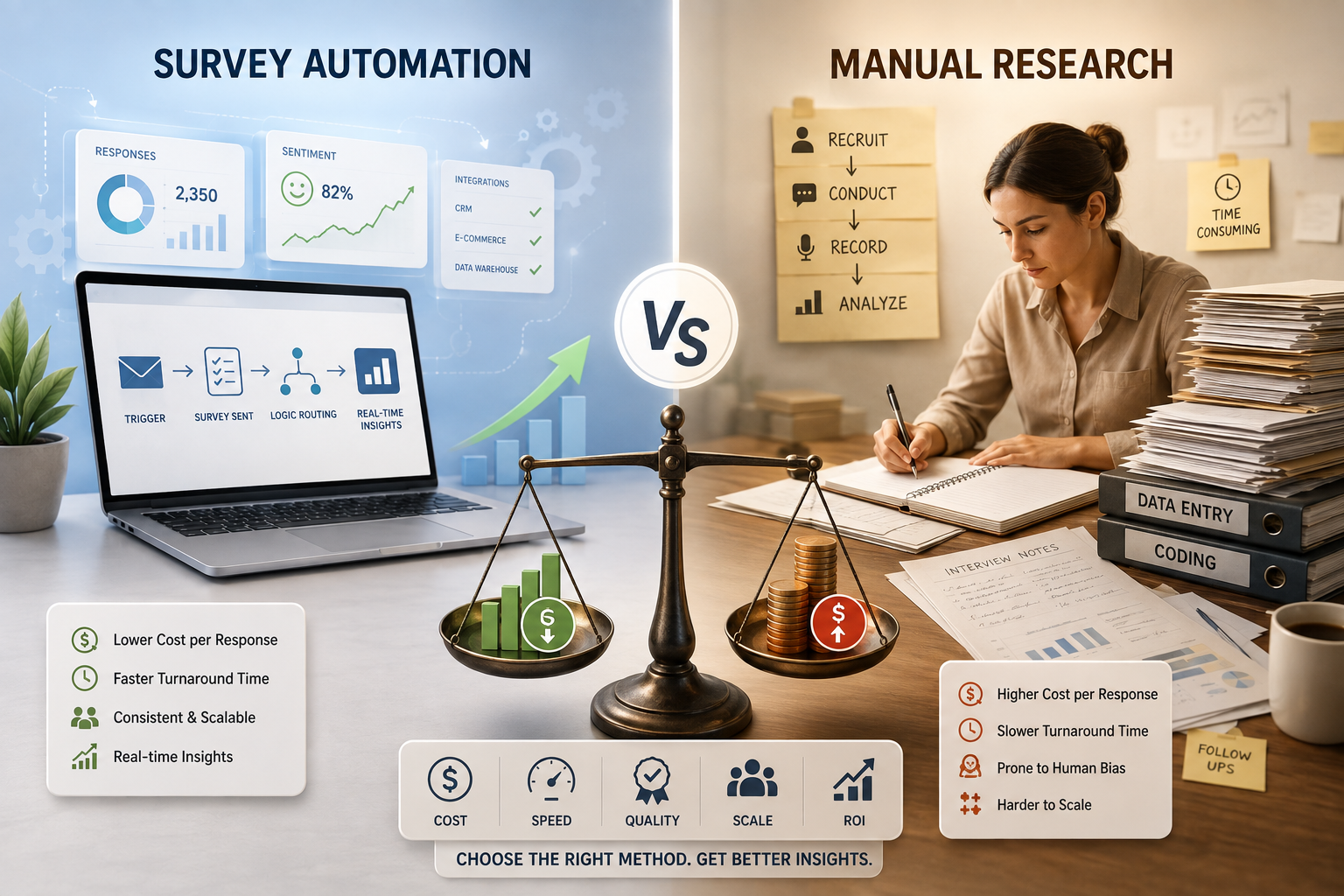
Compare survey automation and manual research on cost, speed, and accuracy to see which method gives better ROI for your business.
Every research team eventually asks the same question: should we automate data collection or keep it manual? The answer affects budget, timelines, and how much you can trust the results. This article breaks down the real cost and return differences between survey automation and manual research, so you can pick the right method for your next project.
What Survey Automation Actually Means
Survey automation uses software to handle the repetitive parts of data collection. This includes sending surveys on a schedule, routing responses based on logic, cleaning data automatically, and generating reports without manual entry.
Common automated survey tools handle:
- Trigger based distribution (for example, sending a survey twenty-four hours after a purchase or return)
- Skip logic and branching based on prior answers
- Real-time dashboards and sentiment tagging
- Integration with CRM or ecommerce platforms Automation does not remove the need for good survey design. It removes the manual labor of sending, tracking, and compiling responses.
What Manual Research Involves
Manual research relies on human effort at each stage: designing the questionnaire, recruiting participants, conducting interviews, or distributing paper and email surveys, and then coding and analyzing the responses by hand or in spreadsheets.
This approach is common for:
- In depth interviews where nuance matters
- Small sample studies
- Research requiring a human interviewer to build rapport
- Niche audiences that automated panels do not reach well Manual research gives more control over each interaction but takes far more time per respondent.
Cost Comparison
Cost is usually the first factor teams look at, and it depends heavily on scale.
Survey automation costs:
- Software subscription (fixed or usage based)
- Initial setup time
- Lower per response cost as volume increases
Manual research costs:
- Staff hours for outreach, interviews, and data entry
- Recruitment or incentive costs per participant
- Higher per response cost regardless of volume
For a study involving a few dozen respondents, manual research can be cheaper since there is no software overhead to justify. Once you move past a few hundred responses, automation cost per response drops sharply while manual labor cost keeps climbing.
Speed and Turnaround Time
Automated surveys can go out within minutes of a trigger event and start collecting responses immediately. A study that would take a manual team several weeks to distribute and follow up on can often be completed by an automated system in days.
Manual research takes longer because every step, from scheduling interviews to transcribing notes, requires a person to complete it before moving to the next step. This is not a flaw. It is simply the nature of hands on work.
If your business needs to make a decision quickly, such as identifying why product returns spiked this month, automation usually wins on speed.
Data Quality and Accuracy
This is where the comparison gets more nuanced.
Automated surveys are consistent. Every respondent sees the same question wording, the same logic, and the same follow up timing. This reduces interviewer bias and makes results easier to compare across time periods.
Manual research, particularly interviews, can surface details an automated survey would miss. A skilled interviewer can ask a follow up question on the spot, notice hesitation, or dig into an unexpected answer. Automated systems cannot do this unless the branching logic was built to anticipate it.
In practice, many research teams combine both. Automated surveys handle the broad data collection, and a smaller batch of manual interviews validates and adds depth to the findings.
Sample Size and Scale
Automation clearly wins when scale matters. A platform can send thousands of surveys and process responses without added labor cost. Manual research does not scale the same way. Doubling your sample size with manual methods usually means doubling your team's workload or your budget.
If your goal is a statistically reliable sample across a large customer base, automation is the practical choice. If your goal is a handful of deep, qualitative conversations, manual research remains the better fit.
Which Delivers Better ROI
ROI depends on what you are measuring and how often you need the data.
Choose survey automation when:
- You need recurring or ongoing feedback loops
- Your sample size is in the hundreds or thousands
- Speed of insight affects business decisions
- You want consistent, comparable data over time
Choose manual research when:
- The study is small and one-time
- You need deep qualitative insight
- Your audience is hard to reach through automated channels
- Budget for software is limited but staff time is available
For most ecommerce and consumer brands running repeated studies, such as post purchase feedback or return analysis, automation delivers a better return because the cost per insight drops as volume grows. A real world example: a D2C brand used automated post purchase surveys to cut return rates from 25 percent to 17 percent within six months, saving $120,000 in logistics costs in two quarters.
FAQ
Is survey automation less accurate than manual research?
No, not inherently. Automation removes interviewer bias and keeps question delivery consistent. Manual research can add depth through follow up questions, but it introduces more variability between interviewers.
Can small businesses benefit from survey automation?
Yes. Many platforms offer usage based pricing, so small businesses only pay for the volume they need. If feedback collection happens regularly, automation still saves time even at smaller scale.
Should I combine automation with manual research?
In many cases, yes. Automated surveys collect broad data efficiently, while a smaller set of manual interviews can explain the "why" behind the numbers.
How long does it take to set up survey automation?
Setup typically takes a few days to a couple of weeks, depending on integrations with your existing systems like CRM or ecommerce platforms.
What is the biggest hidden cost of manual research?
Staff time. Interviews, data entry, and manual coding of responses often take far more hours than teams initially budget for, especially as sample size grows.